Back to the list
View the entire gallery
2 photos
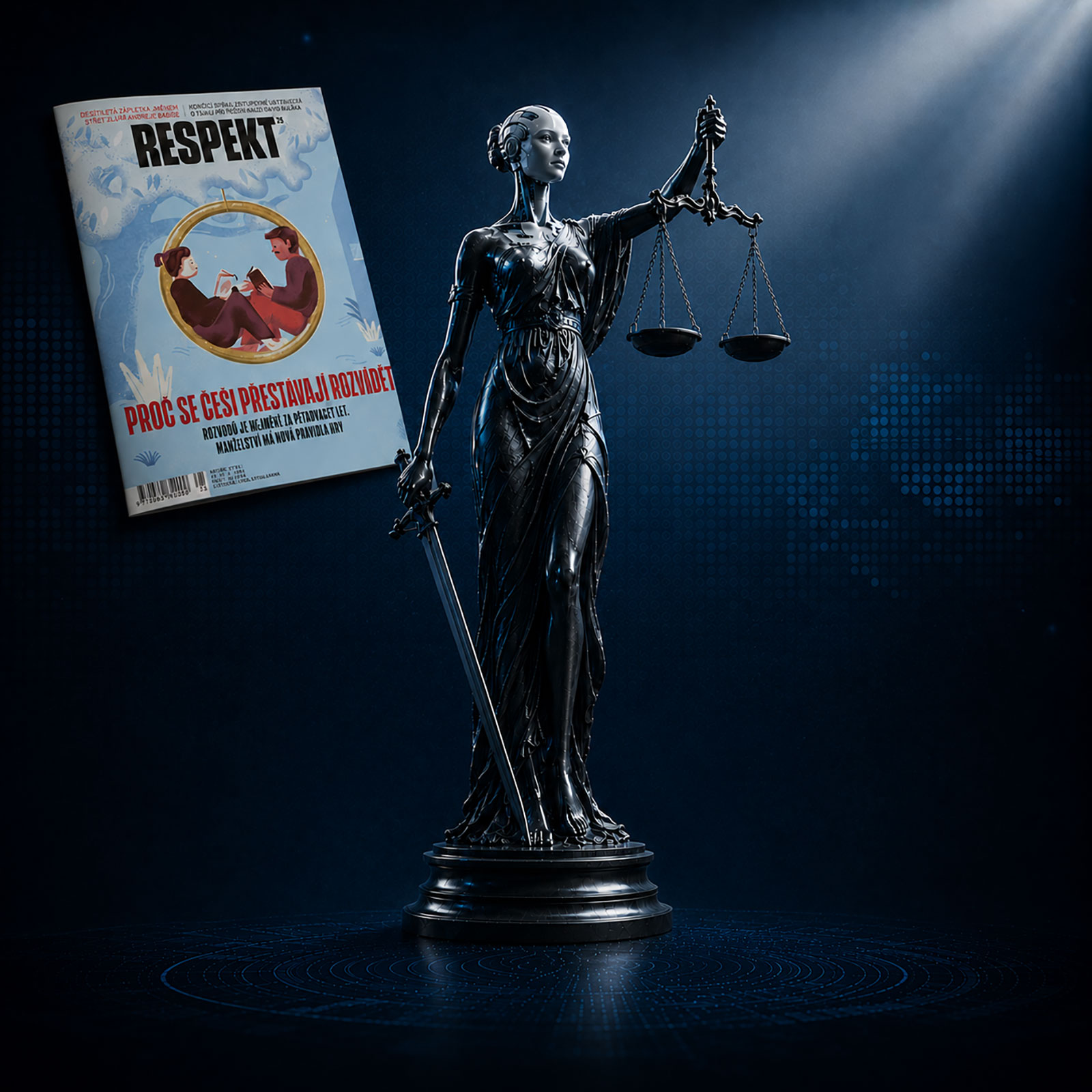
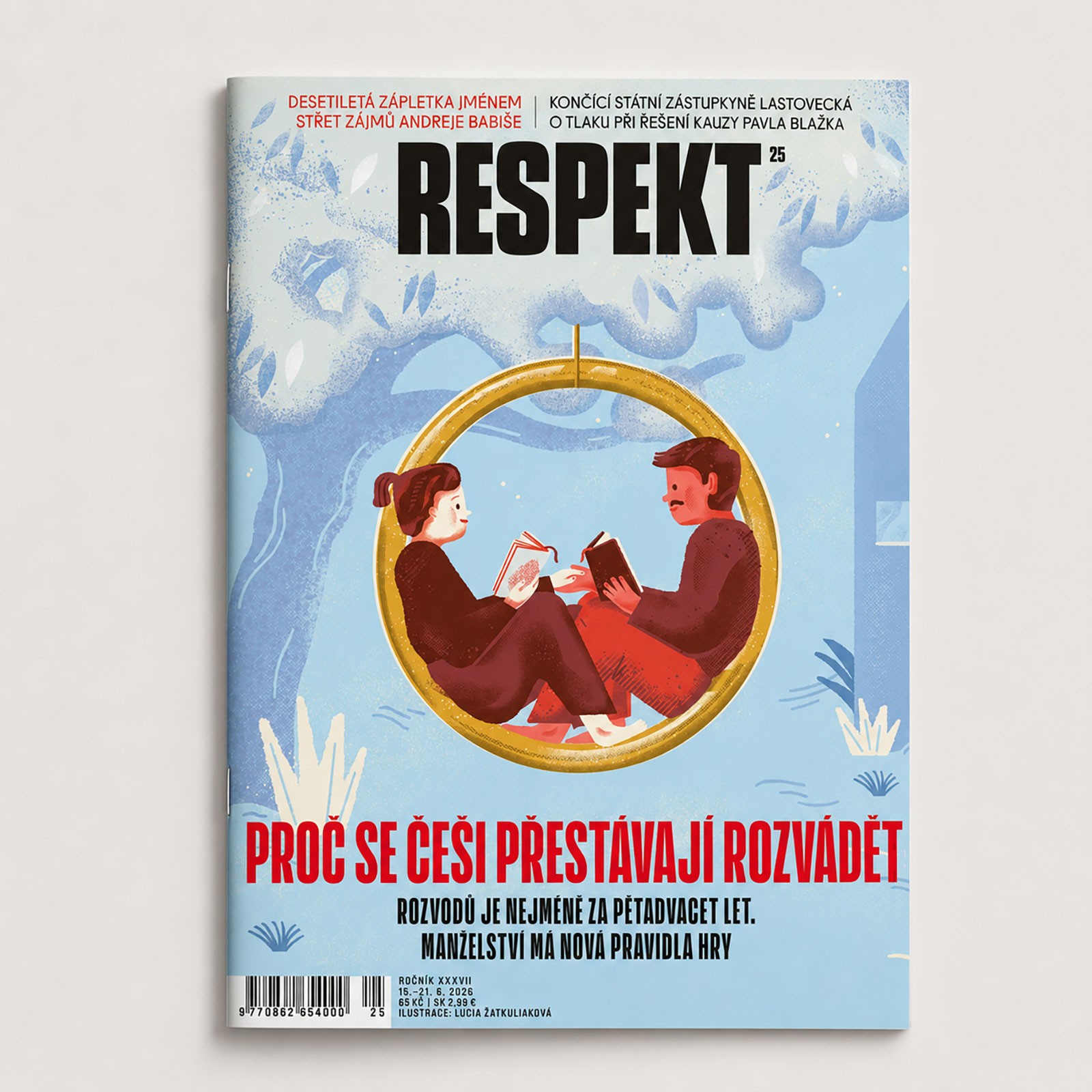
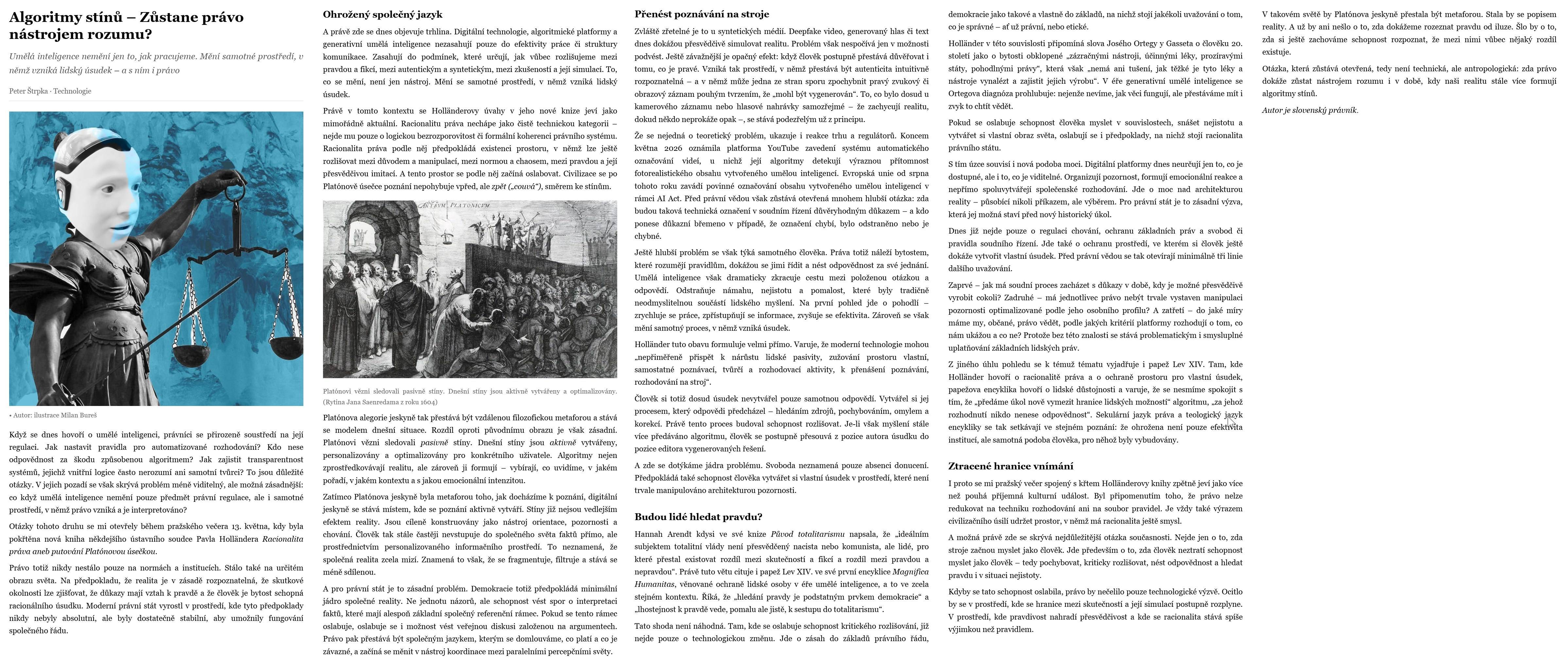
Peter Štrpka, founding partner of the law firm soukeník — štrpka, has published an essay in Respekt, the Czech socio-political weekly and online magazine, on whether law can remain an instrument of reason at a time when human judgement is increasingly shaped by artificial intelligence. The essay was published in the Technology section under the title Algorithms of Shadows – Will Law Remain an Instrument of Reason?
Artificial intelligence is not only changing the way we work. It is changing the very environment in which human judgement is formed – and, with it, the law.
When artificial intelligence is discussed today, lawyers naturally focus on its regulation. How should rules for automated decision-making be set? Who bears liability for damage caused by an algorithm? How can the transparency of systems be ensured when even their creators often do not understand their internal logic? These are important questions. In the background, however, there lies a less visible, but perhaps more fundamental problem: what if artificial intelligence is changing not only the subject matter of legal regulation, but also the very environment in which law is created and interpreted?
These questions opened up for me during an evening in Prague on 13 May, when the new book by former Constitutional Court judge Pavel Holländer, Racionalita práva aneb putování Platónovou úsečkou (The Rationality of Law, or a Journey Along Plato’s Divided Line), was ceremonially launched.
Law has never rested solely on norms and institutions. It has also rested on a certain image of the world. On the assumption that reality is, in principle, knowable; that factual circumstances can be established; that evidence has a relationship to truth; and that the human being is a creature capable of rational judgement. The modern state governed by the rule of law grew up in an environment where these assumptions were never absolute, but were sufficiently stable to make the functioning of a shared order possible.
A Shared Language Under Threat
And it is precisely here that a crack is now appearing. Digital technologies, algorithmic platforms and generative artificial intelligence do not intervene only in the efficiency of work or the structure of communication. They intervene in the conditions that determine how we distinguish at all between truth and fiction, between the authentic and the synthetic, between experience and its simulation. What is changing is not merely the tool. The very environment in which human judgement is formed is changing.
It is in this context that Holländer’s reflections in his new book appear exceptionally timely. He does not understand the rationality of law as a purely technical category – he is not concerned merely with logical non-contradiction or the formal coherence of a legal system. For Holländer, the rationality of law presupposes the existence of a space in which it is still possible to distinguish between reason and manipulation, between norm and chaos, between truth and its persuasive imitation. And this space, in his view, is beginning to weaken. Civilisation is not moving forwards along Plato’s divided line of knowledge, but backwards (‘reversing’), towards the shadows.
Plato’s allegory of the cave thus ceases to be a distant philosophical metaphor and becomes a model of our present situation. The difference from the original image, however, is fundamental. Plato’s prisoners watched shadows passively. Today’s shadows are actively created, personalised and optimised for a specific user. Algorithms do not merely mediate reality; they also shape it – selecting what we will see, in what order, in what context and with what emotional intensity.
Whereas Plato’s cave was a metaphor for the way in which we arrive at knowledge, the digital cave is becoming a place where knowledge is actively produced. Shadows are no longer a side effect of reality. They are deliberately constructed as an instrument of orientation, attention and behaviour. Increasingly, the human being does not enter the shared world of facts directly, but through a personalised information environment. This does not mean that shared reality disappears altogether. It does mean, however, that it is fragmented, filtered and made less shared.
For the state governed by the rule of law, this is a fundamental problem. Democracy presupposes a minimal core of shared reality. Not unity of opinion, but the ability to conduct a dispute over the interpretation of facts that have at least a basic common frame of reference. If this frame weakens, so too does the possibility of public discussion based on arguments. Law then ceases to be the shared language through which we agree on what applies and what is binding, and begins to turn into a tool of coordination between parallel perceptual worlds.
Transferring Cognition to Machines
This is particularly evident in the case of synthetic media. A deepfake video, a generated voice or a generated text can now convincingly simulate reality. The problem, however, does not lie only in the possibility of deception. Even more serious is the opposite effect: when a person gradually ceases to trust even what is genuine. An environment thus emerges in which authenticity ceases to be intuitively recognisable – and in which one party to a dispute may challenge a genuine audio or video recording merely by claiming that it ‘could have been generated’. What has until now been taken for granted in the case of a camera recording or a voice recording – that it captures reality unless someone proves otherwise – becomes suspect in principle.
That this is not a theoretical problem is shown by the response of the market and of regulators. At the end of May 2026, the YouTube platform announced the introduction of an automatic labelling system for videos in which its algorithms detect a significant presence of photorealistic content created by artificial intelligence. From August of this year, the European Union is introducing mandatory labelling of content created by artificial intelligence under the AI Act. Yet a far deeper question remains open for legal scholarship: whether such technical labels will constitute trustworthy evidence in judicial proceedings – and who will bear the burden of proof where a label is missing, has been removed or is incorrect.
An even deeper problem, however, concerns the human being. Rights belong to beings who understand rules, are able to follow them and bear responsibility for their actions. Artificial intelligence, however, dramatically shortens the path between a question posed and an answer given. It removes the effort, uncertainty and slowness that have traditionally been an inseparable part of human thinking. At first sight, this is a matter of convenience – work is accelerated, information is made more accessible, efficiency is increased. At the same time, however, the very process by which judgement is formed is changing.
Holländer formulates this concern very directly. He warns that modern technologies may ‘contribute disproportionately to an increase in human passivity, to the narrowing of the space for one’s own independent cognitive, creative and decision-making activity, and to the transfer of cognition and decision-making to the machine’.
Until now, the human being has not formed judgement through the answer alone. Judgement has been formed by the process that preceded the answer – by searching for sources, doubting, making mistakes and correcting them. It was precisely this process that built the ability to distinguish. If, however, thinking is increasingly handed over to an algorithm, the human being gradually moves from the position of author of judgement to that of editor of generated solutions.
And here we touch the core of the problem. Freedom does not mean only the absence of coercion. It also presupposes the ability of the human being to form his or her own judgement in an environment that is not permanently manipulated by the architecture of attention.
Will People Seek the Truth?
Hannah Arendt once wrote in The Origins of Totalitarianism that ‘the ideal subject of totalitarian rule is not the convinced Nazi or Communist, but people for whom the distinction between fact and fiction and the distinction between true and false no longer exist’. This very sentence is also cited by Pope Leo XIV in his first encyclical, Magnifica Humanitas, devoted to the protection of the human person in the age of artificial intelligence, and in precisely the same context. He says that ‘the search for truth is an essential element of democracy’ and that ‘indifference to truth leads, slowly but surely, to a descent into totalitarianism’.
This agreement is not accidental. Where the ability of critical discernment is weakened, what is at stake is no longer merely a technological change. It is an intervention in the foundations of the legal order, of democracy as such and, indeed, in the foundations on which any reflection on what is right rests – whether legal or ethical.
In this connection, Holländer recalls the words of José Ortega y Gasset about the person of the twentieth century as a being surrounded by ‘miraculous instruments, effective medicines, far-sighted states, comfortable rights’, who nevertheless ‘has not the slightest idea how difficult it is to invent these medicines and instruments and to secure their production’. In the age of generative artificial intelligence, Ortega’s diagnosis deepens: not only do we not know how things work, but we are losing the habit of wanting to know.
If the human capacity to think in context, to endure uncertainty and to form one’s own image of the world is weakened, then the very assumptions on which the rationality of the state governed by the rule of law rests are weakened as well.
Closely connected with this is a new form of power. Digital platforms today determine not only what is available, but also what is visible. They organise attention, shape emotional reactions and indirectly co-create social decision-making. This is power over the architecture of reality – operating not by command, but by selection. For the state governed by the rule of law, this is a fundamental challenge, one that may be placing it before a new historical task.
Today, it is no longer merely a matter of regulating behaviour, protecting fundamental rights and freedoms or setting the rules of judicial proceedings. It is also a matter of protecting the environment in which the human being is still able to form his or her own judgement. Legal scholarship is therefore confronted with at least three lines of further reflection.
First – how should judicial proceedings deal with evidence at a time when anything can be convincingly manufactured? Secondly – does the individual have a right not to be permanently exposed to manipulation of attention optimised according to his or her personal profile? And thirdly – to what extent do we, as citizens, have a right to know the criteria by which platforms decide what they will show us and what they will not? Because without such knowledge, even the meaningful exercise of fundamental human rights becomes problematic.
Pope Leo XIV approaches the same subject from another angle. Where Holländer speaks of the rationality of law and of protecting the space for one’s own judgement, the papal encyclical speaks of human dignity and warns that we must not content ourselves with ‘handing over the task of redefining the limits of human possibilities’ to an algorithm ‘for whose decisions no one bears responsibility’. The secular language of law and the theological language of the encyclical thus meet in the same realisation: that what is under threat is not only the efficiency of institutions, but the very form of the human being for whom they were built.
The Lost Boundaries of Perception
This is also why the Prague evening connected with the launch of Holländer’s book now seems to me, in retrospect, to have been more than merely a pleasant cultural event. It was a reminder that law cannot be reduced to a technique of decision-making or to a set of rules. It is always also an expression of a civilisational effort to preserve a space in which rationality still has meaning.
And perhaps it is here that the most important question of the present is hidden. It is not only a question of whether machines will begin to think like human beings. It is above all a question of whether human beings will lose the ability to think like human beings – that is, to doubt, to distinguish critically, to bear responsibility and to seek truth even in a situation of uncertainty.
If this ability were to weaken, law would not be facing merely a technological challenge. It would find itself in an environment where the boundary between reality and its simulation gradually dissolves. In an environment where truthfulness is replaced by persuasiveness and where rationality becomes the exception rather than the rule.
In such a world, Plato’s cave would cease to be a metaphor. It would become a description of reality. And the question would no longer be whether we are able to distinguish truth from illusion. It would be whether we still retain the ability to recognise that there is any difference between them at all.
The question that remains open is therefore not technical, but anthropological: whether law can remain an instrument of reason even at a time when our reality is increasingly shaped by algorithms of shadows.
View the entire gallery
2 photos